 Opening hours:
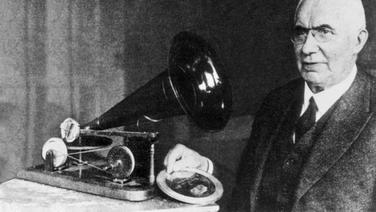
Unlike Edison’s phonograph with wax cylinders, the gramophone stored sound on flat circular discs.
This new format offered several major advantages.
Records could be easily duplicated and mass-produced using pressing techniques.
For the first time, this allowed the wide distribution of recorded music.
Sound was recorded through side-to-side movements of the stylus in the groove of the disc.
This technique is known as lateral recording.
It allowed more stable playback and improved sound quality compared to earlier systems.
Because records could be produced in large quantities, a global market for recorded music began to develop.
Music could now be purchased, collected, and played at home.
Berliner's invention had a profound influence on the music industry for decades and is considered a key milestone in the history of recorded sound.